


New tire plants reshape global production

A new investment cycle is changing the geographic distribution of global tire production. A 54PSI study has identified more than 20 new plant projects, additional manufacturing units and industrial complexes under development, covering passenger, light truck, truck and bus, motorcycle, bicycle, agricultural, industrial, construction and mining tires. The projects with disclosed financial figures represent more […]
por Mateus Taday em 20/07/2026 - Atualizado em 21/07/2026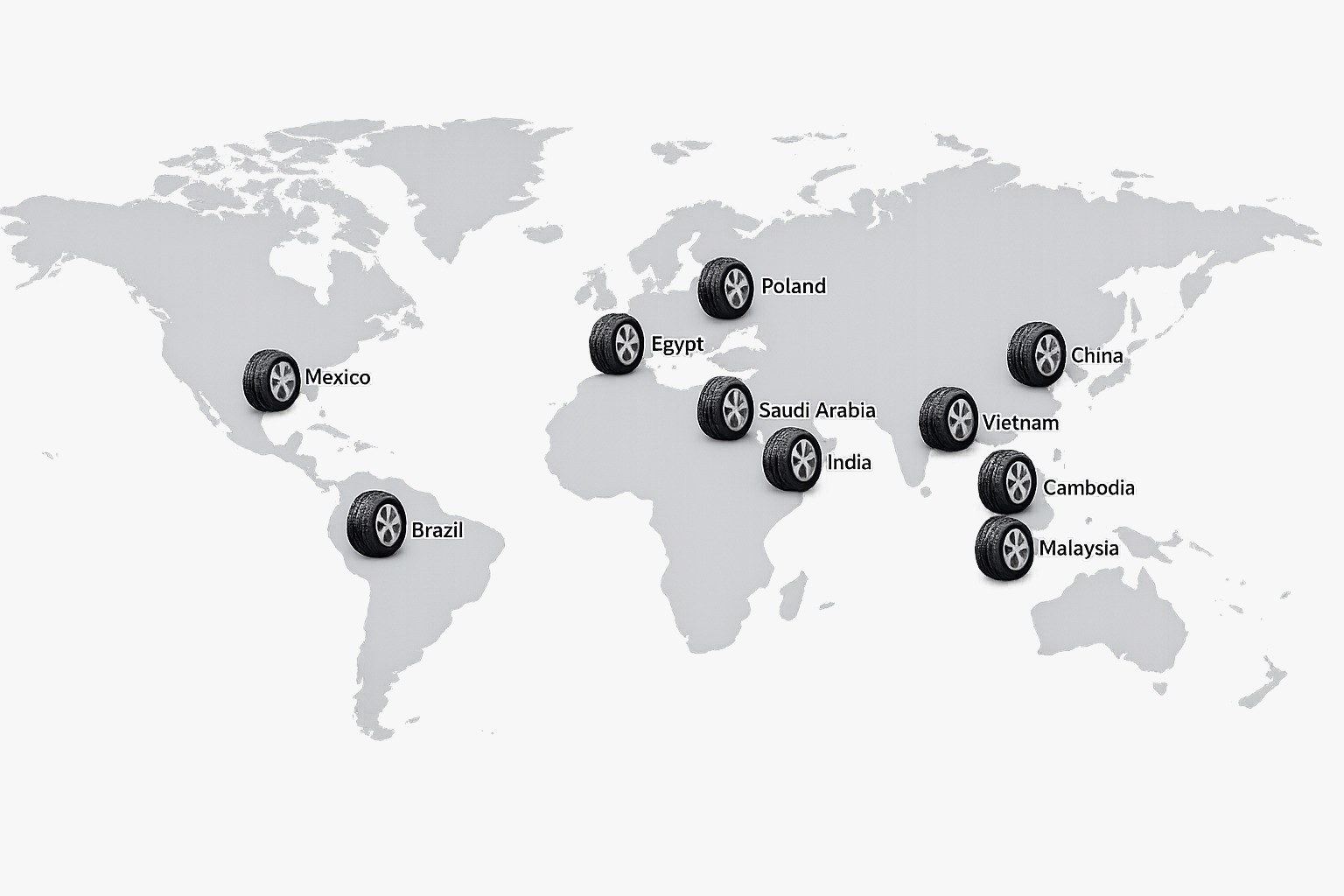
A new investment cycle is changing the geographic distribution of global tire production. A 54PSI study has identified more than 20 new plant projects, additional manufacturing units and industrial complexes under development, covering passenger, light truck, truck and bus, motorcycle, bicycle, agricultural, industrial, construction and mining tires.
The projects with disclosed financial figures represent more than US$8 billion in promised investment. The total could exceed US$10 billion when future phases, planned expansions and developments still dependent on licensing, financing or final investment decisions are included.
Published initial capacity for the most clearly defined projects exceeds 70 million passenger, light truck, truck and bus tires annually. Under a maximum scenario incorporating Sailun’s long-term Egyptian plans, Prinx Chengshan’s potential Malaysian expansion and other multi-stage projects, announced capacity exceeds 100 million units.
These totals do not represent capacity that will come online simultaneously. The pipeline includes plants in physical construction, pre-construction developments, sites being prepared, recently established joint ventures and investments that remain at memorandum or planning stage.
The study also reports OTR and mining capacity separately. Output in those segments is commonly stated in tonnes because a single ultra-large mining tire can weigh several tonnes. Comparing those factories directly with passenger, motorcycle or bicycle tire plants would be misleading.
New tire factories and projects
| Manufacturer or project | Location | Segments | Initial annual capacity | Announced potential | Promised investment | Status in July 2026 |
|---|---|---|---|---|---|---|
| Triangle Tire | Svay Rieng, Cambodia | PCR, PLT and TBR | 6 million PCR/PLT + 1 million TBR | 7 million | US$462 million | Construction scheduled for 2026 |
| Prinx Chengshan | Kedah, Malaysia | PCR, SUV, LT and TBR | 6 million PLT + 600,000 TBR | 15 million PLT + 1.5 million TBR | About US$380 million | Construction started in November 2025 |
| Sailun, first phase | Ain Sokhna, Egypt | PCR and TBR | 3 million PCR + 600,000 TBR | More than 10 million under original plan | US$291 million for phase one | Under construction |
| Sailun, second phase | Ain Sokhna, Egypt | PCR and TBR | Additional 6 million PCR + 1.05 million TBR | Part of a larger complex | US$285.43 million | Approved during phase-one construction |
| Sailun, expanded plan | Ain Sokhna, Egypt | PCR, TBR and OTR | Not applicable as one phase | Tens of millions of tires plus OTR | Approximately US$1.14 billion | Long-term plan, not fully under construction |
| Yokohama Rubber | Saltillo, Mexico | PCR and PLT | 5 million | Site prepared for expansion | US$380 million | Under construction; output expected in 2027 |
| Yokohama Rubber OTR | Odisha, India | OTR and mining | 9,150 tonnes | Not disclosed | US$130 million | Construction expected in Q3 2026 |
| Yokohama Rubber OTR | Mexico | OTR, mining, construction and agricultural | 10,650 tonnes | Potential ultra-large OTR equipment | US$115 million | Additional unit planned |
| Pirelli/PIF | Saudi Arabia | Premium passenger tires | 3.5 million | Not disclosed | US$550 million | Implementation; original schedule revised |
| Wanli Tire/Berjaya | Hulu Selangor, Malaysia | PCR and TBR | 5 million PCR + 1.2 million TBR | 6.2 million | US$320 million | Joint venture formed in July 2026 |
| Kumho Tire | Opole, Poland | PCR and light commercial | 6 million | Possible future expansion | US$587 million | Pre-construction; production expected in 2028 |
| ZC Rubber | Ho Chi Minh City, Vietnam | PCR | 5 million | Not disclosed | Approximately US$130 million to US$150 million | Construction scheduled for July 2026 |
| Sunset Tires/XBRI | Ponta Grossa, Brazil | PCR, PLT, TBR, agricultural and specialty | 12.5 million PCR/PLT + 2.5 million TBR + 600,000 agricultural under the original Linglong plan | Around 14.7 million under original announcement | About US$1.19 billion under the Linglong-linked plan | Sunset says project continues, but financing and schedule have not been updated |
| Etor Pneus | Manaus, Brazil | Motorcycle, scooter, bicycle and inner tubes | Not disclosed | Not disclosed | Approximately US$50 million | Industrial installation and production preparation |
| Rubberon | Iranduba, Brazil | Specialty tires using natural rubber | Not disclosed | Not disclosed | Approximately US$1 million to US$2 million | Current status requires confirmation |
| Rolling Plus | Ain Sokhna, Egypt | PCR, light commercial and heavy truck | 2.5 million in phase one | Between 7 million and 8 million | Approximately US$1 billion | Restructured; physical progress not transparent |
| Black Arrow Tire | Yanbu, Saudi Arabia | PCR and TBR | 4 million | Up to 6 million | Approximately US$470 million | Engineering and structuring stage |
| MRF | Sivaganga, India | Automotive segments not yet detailed | Not disclosed | Not disclosed | Approximately US$610 million | MoU signed; subject to permits and incentives |
| Potential Apollo Tyres project | Tamil Nadu, India | Not defined | Not disclosed | Not disclosed | Approximately US$350 million | Preliminary evaluation; no final decision confirmed |
| Prinx Chengshan OTR | Rongcheng, China | OTR and mining | 840,000 OTR + 10,000 MTRC | Full capacity by 2029 | About US$160 million | Multi-stage project |
| Other Cambodian projects | Cambodia | Mainly PCR | Some registrations cite up to 4.5 million | Unconfirmed | Not disclosed | Projects require individual verification |
PCR refers to passenger car radial tires. PLT combines passenger and light truck tires. TBR refers to truck and bus radial tires. OTR covers products for construction, earthmoving and mining.
Sunset’s figures require a specific qualification. The original announcement of the proposed Linglong partnership cited US$1.19 billion, 14.7 million tires and a proposed 70% Linglong interest. The joint venture was never formally established, however, and Sunset later said the Chinese manufacturer had not contributed capital. The original capacity and investment remain useful as historical project references, not as currently secured funding.
The project’s evolution illustrates how industrial announcements can change. In May 2026, Linglong said the development had not advanced substantially, while Sunset maintained that it would proceed. 54PSI covered the dispute in Linglong cancels China plant as Brazilian project faces conflicting accounts.
Southeast Asia attracts Chinese manufacturing
Cambodia, Malaysia and Vietnam form the leading corridor for the overseas expansion of Chinese tire manufacturers. Triangle Tire, Prinx Chengshan, Wanli and ZC Rubber are developing plants outside China to move production closer to customers, secure access to raw materials and diversify logistics and trade risk.
Triangle announced US$462 million for its first major international base. The Cambodian project is designed to manufacture 6 million passenger and light truck tires and 1 million commercial tires annually. 54PSI reported the development in Triangle Tire announces US$462 million Cambodian plant.
In Malaysia, Prinx Chengshan started construction at Kedah Rubber City. Phase one will provide capacity for 6 million PLT and 600,000 TBR tires, supported by estimated investment of US$380 million. The site was designed for a potential 15 million PLT and 1.5 million TBR tires, but that maximum should not be treated as committed capacity.
Wanli created a joint venture with Berjaya Property for a 6.2-million-tire plant in Selangor. Announced investment totals US$320 million. The project was covered by 54PSI in Wanli plans second Southeast Asian tire factory.
ZC Rubber intends to establish a first phase in Vietnam for 5 million passenger radial tires per year. International reports place the investment between US$130 million and US$150 million, depending on the exchange rate used to convert the original yuan figure.
Egypt could become an export hub
Egypt hosts the largest individual projects identified in the study. Sailun and Rolling Plus have presented plans that together could exceed US$2 billion.
Sailun’s first phase involves US$291 million, 3 million passenger tires and 600,000 truck tires. The manufacturer subsequently approved another US$285.43 million to add 6 million PCR and 1.05 million TBR tires before completing the initial unit. 54PSI covered the developments in Sailun to invest in Egyptian tire plant and Sailun expands Egypt project before completing factory.
Later disclosures referred to a much larger complex including tens of millions of semi-steel and all-steel tires and OTR output. Those figures represent a long-term scenario and cannot be added as though all production lines were currently being built.
Rolling Plus, also located in Ain Sokhna, was presented with full capacity of between 7 million and 8 million tires and investment of approximately US$1 billion. It has undergone corporate restructuring and has less publicly documented physical progress than Sailun.
Saudi Arabia targets import substitution
The joint venture between the Public Investment Fund and Pirelli is expected to build capacity for 3.5 million passenger tires per year, supported by US$550 million in investment. PIF will hold 75%, while Pirelli will own 25% and act as technology partner. 54PSI reported the agreement in PIF and Pirelli announce Saudi tire plant joint venture.
The original schedule called for production in 2026, but later information moved the expected start to 2027. Part of the output will be sold under the Pirelli brand, with the remainder using a new regional brand.
Black Arrow Tire has proposed another Saudi project in Yanbu, backed by approximately US$470 million. Initial capacity would be 4 million passenger tires, potentially rising to 6 million with commercial products. The project remains less clearly documented.
Mexico adds passenger and OTR capacity
Yokohama is constructing a passenger tire plant in Saltillo with annual capacity for 5 million tires and investment of US$380 million. Production is scheduled for the first quarter of 2027. 54PSI covered the project in Another tire factory will be built in Mexico, this time by Yokohama.
The manufacturer is also planning an additional OTR unit in Mexico and another in Odisha, India. The two projects represent US$245 million and a combined announced capacity of 19,800 tonnes per year.
Those figures must remain separate from unit-based automotive capacity. A light truck tire and an ultra-large mining tire are not comparable on a per-unit basis.
Brazil combines projects of very different scales
Etor Pneus is implementing a factory in Manaus for motorcycle, scooter and bicycle tires, together with inner tubes. The updated project approved by Suframa represents approximately R$283.1 million, equivalent to about US$50 million.
Annual capacity has not been disclosed. Comércio e Indústria de Pneus Amazônia, Amazônia Pneus, Grupo Cairu’s tire project and Etor should not be counted as four separate plants. Available documentation indicates that those names are associated with the same development.
Rubberon in Iranduba is a separate, smaller project focused on specialty tires using Amazonian natural rubber. The most detailed public information predates 2026, preventing a confident classification as an active construction site.
In Ponta Grossa, Sunset says it intends to continue the XBRI manufacturing project following the end of negotiations with Linglong. It has not yet publicly presented a revised capital structure, new industrial partner, updated budget or definitive schedule.
Kumho prepares its first European plant
Kumho confirmed Opole, Poland, as the location for its first European tire factory. The unit is expected to manufacture 6 million tires annually, supported by US$587 million in investment, with production scheduled for August 2028.
The project still needs to advance through engineering, permitting and supplier definition. 54PSI published the details in Kumho confirms Polish plant, with production starting in 2028.
Tariffs and anti-dumping measures accelerate regionalization
Trade barriers help explain the geographic spread of new tire investment. In July 2026, the European Union imposed definitive anti-dumping duties ranging from 4.3% to 45.3% on passenger and light commercial tires originating in China. The European Commission concluded that the products were entering the market at dumped prices and causing injury to the regional industry. 54PSI covered the decision in EU imposes tariffs on Chinese tires.
The United States also maintains a combination of anti-dumping, countervailing and product-specific tariffs on tires from different origins. In 2025, the country added a 25% tariff on certain imported tires and auto parts under Section 232, increasing pressure on global supply chains. 54PSI reported the measure in 25% tariff on tires and auto parts takes effect in the US.
Brazil also applies import tariffs and anti-dumping duties to specific tire categories and origins. In agricultural tires, a request involving imports from India triggered concern among distributors and importers, as reported in Anti-dumping request on Indian agricultural tires raises concerns.
Such measures can support domestic production and address pricing regarded as unfair, but they can also raise costs for distributors, transport operators, farmers and consumers. A further possible consequence is trade diversion. When one market becomes less accessible, manufacturers may redirect exports or establish plants in countries not covered by the original measure. 54PSI examined that risk in European barriers could redirect tires to Latin America.
Plants in Malaysia, Cambodia, Vietnam, Mexico and Egypt can reduce dependence on direct exports from China. Manufacturing in another country, however, does not guarantee permanent tariff-free access. Authorities may investigate subsidies, local content, circumvention or sudden changes in trade flows. The likely outcome is a more regionalized tire industry combined with closer scrutiny of each product’s real origin.
Confirmed potential exceeds 70 million tires
Adding only projects with published capacity and a reasonable degree of progress, while excluding maximum long-term scenarios, produces an estimated potential of:
- 58 million to 65 million passenger, SUV and light truck tires per year;
- 8 million to 10 million truck and bus tires;
- 19,800 tonnes of OTR capacity from Yokohama’s two projects;
- additional motorcycle, bicycle and specialty tire output that remains undisclosed;
- more than US$6 billion in projects with a defined industrial scope.
Including projects under restructuring, such as Sunset and Rolling Plus, and the maximum Sailun and Prinx Chengshan plans takes the potential beyond 100 million tires and approximately US$10 billion.
The capacity that ultimately reaches the market will depend on construction execution, financing, trade policy and demand in the regions each facility is intended to serve. Rather than a simple race for volume, the current investment cycle points to the formation of new regional tire manufacturing networks.